

Government's counsel Mohan Parasaran has said he was left out of the details of a special leave petition filed by petroleum ministry in Supreme Court seeking annulment of a family MoU between Mukesh and Anil Ambani group firms on gas supply.
The first of the promotional roadshows for 70 blocks offered under the eighth edition of New Exploration Licensing Policy and 10 coal-bed methane areas will be held in Mumbai on August 8, a petroleum ministry official said. On April 9, India launched the eighth round of auction to give away blocks for exploration under NELP with August 10 being the last date for bidding. But it was deferred over ambiguity on tax holiday for natural gas.
Three oil companies have submitted a concept paper to the petroleum ministry for differential pricing of diesel for direct consumers like Railways and power producers who they want to charge market price and limit subsidised sales to transport and agriculture sectors, sources said. Industrial units like power generators find subsidised diesel cheaper than freely priced fuel oil and naphtha, pushing demand that has forced refiners import the fuel to meet the requirement.
Domestic LPG costs Rs 348.89 less than the cylinders meant for commercial use and this difference often leads them into restaurants and hotels who are supposed to use only industrial LPG, a Petroleum Ministry official said. All cylinders will be tagged with a unique number and consumers will be issued smart cards. Every time a refill is delivered, the unique number would be stored on the smart cards.

A massive drone strike on the world's largest crude-processing facility operated by Saudi Arabia's Aramco has driven oil prices to their highest level in nearly four months. The attack has knocked out over half of Saudi Arabia's production as it cut 5.7 million barrels per day or over 5 per cent of the world's supply.
Petroleum ministry has sought an increase of Rs 2.50 per litre in petrol and Rs 1.30 per litre in diesel prices in line with hike in tax rates announced in Budget and asked oil firms to bear the impact of surge in global oil prices.

Scandal is a result of callous administrative approach.
The Supreme Court today issued notices to the Union ministries of defence and petroleum and the Uttar Pradesh government on a PIL alleging that the widows of Kargil martyrs had not yet been given benefits promised by the government

Jethmalani described the gas row between the Ambani brothers as a saga where the government has kept the public interest at the farthest and huge wealth has been put in private pockets.
The government has already decided to accord priority to fertiliser and power units for allocation of gas from the Krishna-Godavari basin. According to sources, the empowered group of ministers on gas, which met last week, has made it clear it will be able to provide additional gas to steel firms only after meeting the requirements of the power and fertiliser units. Among the steel majors, Essar, Ispat and Vikram Ispat have gas-based units.
The Cabinet, scheduled to meet on Thursday, may reduce petrol price by Rs 5 a litre, diesel by Rs 3 per litre and domestic LPG by Rs 25 per cylinder, giving relief to the common man and further easing inflationary pressures.

A proposal for extension from the Oil Ministry is pending clearance from Central Vigilance Commission and the Central Bureau of Investigation, which is probing allegations that he favoured Mukesh Ambani-led RIL in lieu of personal benefits.
The government may further reduce petrol, diesel and domestic LPG prices just before the General Elections are announced in February, a senior official said.
The finance ministry is believed to have objected to some provisions of the policy.
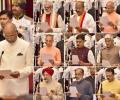
'The days when less government, more governance were spoken of are well and truly behind us.' 'More government, it is now believed, means more governance,' says Saisuresh Sivaswamy.

Dubbing as "most unfortunate" the advertisement campaign against it by the Anil Ambani group, the government on Friday hit back, saying the propaganda was unleashed on a sub-judice matter.

The Cairn-ONGC-Videocon consortium had last month written to the petroleum ministry seeking a 57 per cent hike in the Ravva Satellite field gas price citing provision in the Production Sharing Contract for the field.
The petroleum ministry on Wednesday pledged support to power firm NTPC in its legal battle to get natural gas from Mukesh Ambani-led RIL at a price committed in 2004 and said the public sector unit's interests will not be compromised.
NTPC Ltd on Thursday said it was taking legal opinion on the impact of a court battle between Ambani brothers group firms over gas supply and a related government petition on its ongoing case with Mukesh Ambani-led RIL.
OIL, which produces 3.5 million tonnes a year of oil, will offer 2.64 crore equity shares to public in the IPO, while the government will simultaneously sell 10 per cent of its stake in the company to state refiners.
OIL, which produces 3.5 million tonnes a year of oil, will offer 2.64 crore equity shares to public in the IPO, while the government will simultaneously sell 10 per cent of its stake in the company to state refiners.
Consumption of oil products like petrol and diesel dipped to 11.47 million tonnes in May from 11.64 million tonnes in the same month a year ago, according to the data released by the petroleum ministry in New Delhi. Reflecting slowdown in air traffic, jet fuel or ATF consumption was down 6.3 per cent to 376,400 tonnes.
The nuclear-deal-in-the-making with the US has forced the government into a firefighting mode not only domestically, but also internationally, where it is working overtime to avoid straining relations with the key long-time ally -- Russia.
Officers of public sector oil companies have threatened to go on an indefinite strike from August 21 if their demand for higher salaries was not met.

Govt notification on $8.4 a unit price likely by month-end
The directive from 'above' has come to the petroleum ministry on the eve of the departure of the Indian delegation to Tehran for a decisive last round of the trilateral negotiations scheduled to be held there later this week.
Eight candidates, including Najeeb Jung, former joint secretary (exploration) in the petroleum ministry, are in race for the job of chairman and managing director of Oil and Natural Gas Corporation.
On instructions from the Prime Minister's Office for a more uniform distribution of the natural resource, the petroleum ministry had in December 2007 scrapped all contracts for sale of gas produced from PMT fields and nominated GAIL for selling it to 'fuel-starved' fertiliser plants outside Gujarat. But after protests, the ministry agreed to partly restore 3.6 million standard cubic meters per day of gas out of 5.1 mmscmd consumed by RIL's petrochemical plants.
The big-ticket transnational gas pipelines that India was planning seem to be in trouble. Although the government maintains that the three pipelines
Prime Minister Manmohan Singh is believed to have favoured India, Pakistan and Iran together building the over $7 billion gas pipeline, since joint participation will make the project more secure.
Petroleum Secretary M S Srinivasan observed that smaller and more nimble companies are proving formidable and ONGC would have to register exploration successes and strengthen its systems to retain its position in the industry.

More arrests are likely in this case, being probed by the elite crime branch, in the next couple of days.
Oil product consumption in November was 10.99 million tons, a tad higher than 10.77 million tons in the same month last year, according to latest data available from the petroleum ministry. Diesel sales, which had during the first part of current fiscal seen a growth rate of 15-16 per cent, rose by 8.6 per cent to 4.46 million tons in November while demand for petrol was up 5.9 per cent to 914,900 tons.
